


Gantry Crane Capacity in Modular Construction and Block Handling

In modern industrial construction, modular construction and block handling have become essential methods for improving efficiency, safety, and quality control. Whether in shipbuilding, offshore platform fabrication, steel structure assembly, or large-scale infrastructure projects, oversized prefabricated modules must be lifted, transported, and precisely positioned. In this context, gantry cranes play a central role, and their lifting capacity becomes one of the most critical engineering parameters.
Gantry crane capacity in modular construction is not just about how much weight a crane can lift. It is about how safely and accurately the crane can handle large, irregular, and often extremely heavy structural blocks under real industrial conditions.

1. Understanding Modular Construction and Block Handling
Modular construction refers to a building method where large structural components (modules or blocks) are fabricated off-site or in sectional yards, then transported and assembled into a final structure. Instead of assembling everything piece by piece, engineers build:
Steel modules
Precast concrete blocks
Offshore platform sections
Ship hull blocks
Bridge segments
These modules can range from a few tons to several hundred tons each.
Block handling refers to the process of:
Lifting individual modules
Transporting them within the yard
Aligning them with high precision
Installing them into final positions
Because of their size and weight, these operations require heavy duty gantry cranes with carefully engineered capacity systems.
2. Why Gantry Crane Capacity Is Critical in Modular Projects
Unlike standard material handling, modular construction involves:
Extremely heavy single-point loads
Large and uneven load dimensions
High center-of-gravity variation
Precision positioning requirements
Simultaneous lifting with multiple cranes (in some cases)
Because of these factors, gantry crane capacity becomes a defining engineering constraint.
If capacity is underestimated, it can lead to:
Structural overload
Unsafe lifting conditions
Module deformation
Delays in assembly
Increased project risk and cost
If capacity is overestimated, it leads to:
Higher equipment cost
Increased energy consumption
Oversized structural design
Inefficient crane utilization
Therefore, selecting the correct capacity is a balance between safety, precision, and cost efficiency.

3. Typical Gantry Crane Capacity Range in Modular Construction
In modular construction and block handling applications, gantry crane capacities vary widely depending on industry type:
Small modular steel structures: 10–50 tons
Precast concrete segments: 50–150 tons
Shipyard block assembly: 100–600 tons
Offshore platform modules: 300–1500+ tons
For example, in shipbuilding, a single hull block can weigh over 800 tons. In offshore engineering, topside modules can exceed 2000 tons and require synchronized lifting systems.
This means gantry crane capacity is always customized based on project scale and engineering requirements.
4. Load Characteristics of Modular Blocks
One of the most important aspects of capacity design is understanding the nature of the load itself.
Unlike compact loads, modular blocks have:
4.1 Irregular Shape
Modules are often asymmetrical, which creates uneven stress distribution during lifting.
4.2 Off-Center Gravity
The center of gravity may shift depending on internal equipment or structural geometry.
4.3 Flexible Structures
Some modules (especially large steel frames) may deform slightly if not lifted properly.
4.4 Multi-Point Lifting Requirements
Many modules require multiple lifting points using spreader beams or lifting frames.
All these characteristics influence how gantry crane capacity is calculated and applied in real operations.
5. Structural Design Requirements for High-Capacity Gantry Cranes
To support modular construction, gantry cranes must be engineered with strong structural systems, including:
5.1 Double Girder or Box Girder Design
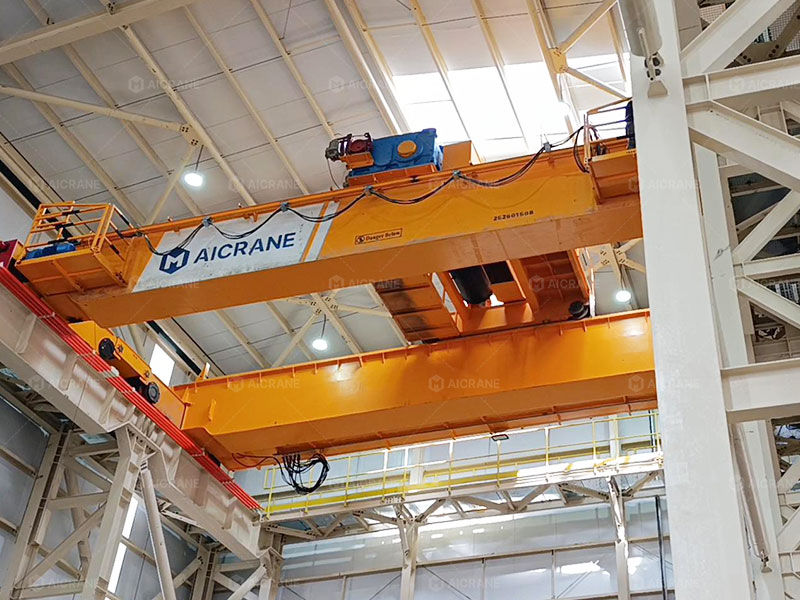
High-capacity cranes typically use box girders or double-girder structures to resist bending and torsional stress caused by large modules.
5.2 Reinforced End Carriages
Wheel loads increase significantly with heavy modules, requiring reinforced end beams and large-diameter wheels.
5.3 Heavy-Duty Legs and Bracing
The gantry legs must resist both vertical load and lateral forces from wind and movement during block positioning.
5.4 High-Stiffness Structure
Deflection control is critical, especially in precision assembly environments such as shipyards.
Even small deflections can cause misalignment during module installation.
6. Influence of Span and Lifting Height on Capacity
In modular construction, crane span and lifting height are often large due to the size of modules and working yards.
6.1 Span Impact
A larger span increases:
Bending moment on the main girder
Structural stress levels
Deflection risk
As a result, two cranes with the same nominal capacity may have completely different structural designs depending on span length.
6.2 Lifting Height Impact
Higher lifting height requires:
Longer hoist ropes
Stronger stability control
Higher safety margins against sway
This becomes especially important when stacking modules or working in multi-level assembly yards.
7. Role of Dynamic Loads in Block Handling
Block handling is not a static operation. During lifting and movement, cranes experience:
Acceleration and deceleration forces
Swinging of large modules
Impact loads during landing
Wind pressure on large surface structures
These dynamic effects can significantly increase effective load beyond static weight.
Therefore, engineering design always applies dynamic amplification factors to ensure that the crane can safely handle real operating conditions, not just theoretical loads.
8. Multi-Crane Lifting Systems for Ultra-Heavy Modules
For extremely large modules, a single gantry crane may not be sufficient. In such cases, tandem lifting systems are used.
This involves:
Two or more rubber tired gantry cranes working simultaneously
Synchronized control systems
Load sharing between cranes
Real-time positioning coordination
In this scenario, capacity design becomes even more complex because engineers must ensure:
Equal load distribution
Synchronized motion control
Structural stability under uneven loading
This is commonly used in offshore platform construction and large ship hull assembly.
9. Safety Factors in Modular Construction Crane Capacity
Because modular blocks are high-value and high-risk loads, safety factors are extremely important.
Engineering design typically includes:
Structural safety factor (1.25–1.6 or higher)
Hoist safety factor (wire rope strength multiple times rated load)
Redundant braking systems
Overload protection devices
Emergency stop and anti-collision systems
These safety systems ensure that even in abnormal conditions, the crane maintains operational integrity.
10. Precision Positioning Requirements
Unlike general lifting applications, modular construction requires high-precision placement.
Gantry cranes must allow:
Millimeter-level alignment accuracy
Smooth horizontal travel
Controlled lowering speed
Minimal sway during placement
This is especially critical in shipbuilding, where hull blocks must align perfectly before welding. Even small misalignment can cause structural stress and increase rework costs.
11. Environmental Factors Affecting Capacity Use
Outdoor modular construction sites are exposed to environmental conditions that directly affect crane performance:
Strong wind loads on large modules
Temperature effects on steel expansion
Rain or humidity affecting friction and braking
Uneven ground settlement in large yards
Engineers must account for these factors when determining usable crane capacity under real-world conditions.
12. Conclusion
Gantry crane capacity in modular construction and block handling is a highly complex engineering parameter that goes far beyond simple lifting weight. It integrates structural strength, dynamic load behavior, span design, precision control, safety systems, and real-world environmental conditions.
From shipyards to offshore platforms and precast concrete plants, high-capacity gantry cranes enable the efficient movement of massive modules that form the backbone of modern industrial construction.
Proper capacity selection ensures not only lifting capability but also operational safety, installation precision, and long-term project efficiency. As modular construction continues to grow globally, the role of high-capacity gantry cranes will become even more critical in shaping the future of heavy engineering and large-scale assembly systems.


Comments