


Inside the Manufacturing Process of 100 Ton Gantry Cranes

A 100-ton gantry crane is not just a heavy lifting machine—it is a highly engineered system designed for extreme loads, long-term structural reliability, and safe operation in demanding industrial environments. These cranes are widely used in shipyards, steel plants, power stations, precast concrete yards, and large-scale fabrication workshops where precision handling of ultra-heavy components is required.
Understanding how a 100-ton gantry crane is manufactured provides valuable insight into why these machines are considered critical infrastructure in modern industry. The process is complex, involving structural engineering, precision machining, welding technology, electrical integration, and rigorous testing procedures.
This article takes you inside the full manufacturing journey of a 100 ton gantry crane - from design and material selection to fabrication, assembly, and final load testing.
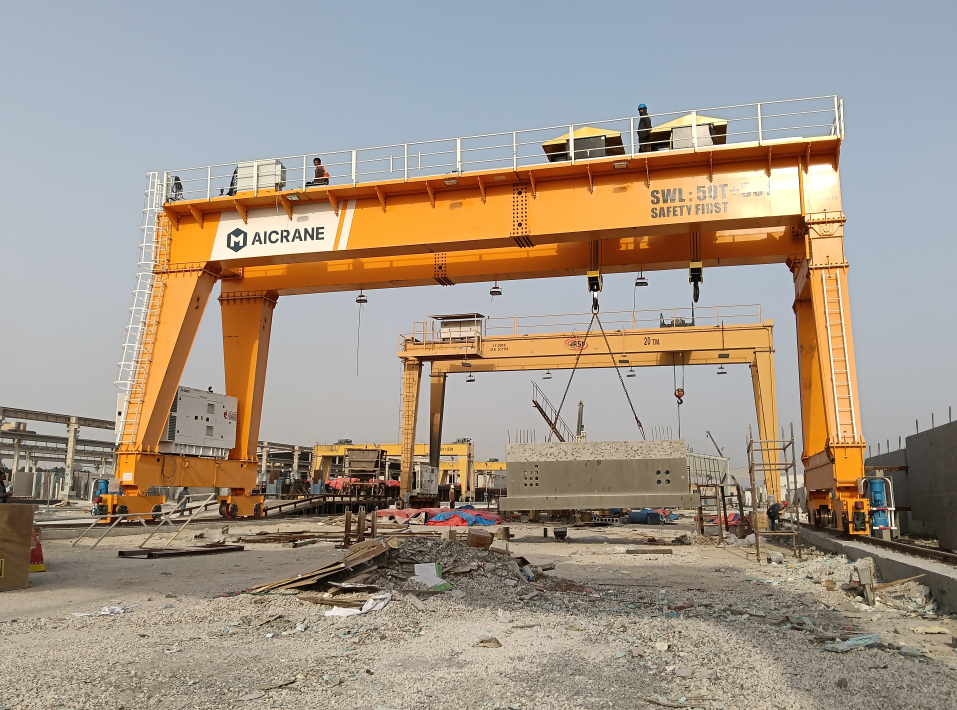
1. Engineering Design and Load Analysis
The manufacturing process begins long before any steel is cut. Engineering design is the foundation of a 100-ton gantry crane’s performance and safety.
At this stage, structural engineers and design teams define:
Rated lifting capacity (100 tons or more with safety margin)
Span length (distance between legs, often 20–50 meters or more)
Lifting height requirements
Duty classification (A5–A8 depending on usage intensity)
Environmental conditions (wind load, temperature, corrosion exposure)
Advanced CAD and finite element analysis (FEA) software are used to simulate stress distribution across the crane structure. These simulations help engineers identify high-stress zones in the main girder, end carriages, and leg structures.
Wind resistance and dynamic loading are especially important for outdoor gantry cranes. A 100-ton load does not remain static; acceleration, braking, trolley movement, and wind forces all create additional stress. The design must account for all of these factors with a significant safety factor.
2. Material Selection and Steel Procurement
Once the design is finalized, the next step is selecting high-strength structural steel. For a 100-ton gantry crane, material quality is critical.
Typically used materials include:
Q355B / Q345B high-strength structural steel
High-tensile alloy steel for critical load-bearing points
Reinforced steel plates for main girders
Precision-machined steel components for wheels and shafts
Steel is sourced from certified suppliers with full traceability. Each batch undergoes material testing, including:
Tensile strength testing
Impact testing at low temperatures
Chemical composition analysis
Ultrasonic flaw detection
Only steel that meets strict international standards is allowed into production.
3. Main Girder Fabrication
The main girder is the backbone of the gantry crane and one of the most important components in the entire structure.
The manufacturing process includes:
Plate Cutting and Preparation
Large steel plates are cut using CNC plasma or laser cutting machines to ensure dimensional accuracy.
Welding and Assembly
The cut plates are assembled into box girders or truss structures depending on crane design. Automatic submerged arc welding (SAW) is commonly used for deep, high-strength weld penetration.
Internal Reinforcement
Inside the box girder, stiffeners are installed to prevent deformation under heavy load.
Stress Relief Treatment
After welding, the girder undergoes heat treatment to relieve internal stress and prevent long-term deformation.
Non-Destructive Testing (NDT)
Ultrasonic and radiographic inspections ensure there are no hidden cracks or weld defects.
This stage is crucial because even minor imperfections in the main girder can affect long-term safety under 100-ton loads.
4. End Carriage and Wheel System Manufacturing
The end carriages support the entire crane and allow movement along rails. For a 100-ton gantry crane, these components must handle enormous horizontal and vertical forces.
Key processes include:
Precision machining of wheel assemblies
Installation of heavy-duty forged wheels
Assembly of drive motors and gearboxes
Alignment calibration for smooth rail travel
Wheel alignment is particularly important. Even a small deviation can lead to uneven load distribution, rail wear, or operational instability.
5. Leg Structure Fabrication
The vertical legs of the heavy duty gantry crane transfer load from the main girder to the ground rails.
Manufacturing steps include:
Steel plate cutting and shaping
Welding of box-type or truss-type leg structures
Installation of diagonal reinforcement supports
Precision drilling for bolt connections
For outdoor cranes, corrosion protection coatings are applied at this stage to improve durability in harsh environments such as coastal or industrial zones.
6. Hoisting Mechanism Production
The hoisting system is the heart of the crane’s lifting capability. In a 100-ton gantry crane, the hoist is typically an open winch-type mechanism.
Main components include:
High-power electric motor system
Multi-layer steel wire rope drum
Heavy-duty gearbox
Brake system with redundancy protection
Hook block with multiple sheaves
Each component is manufactured with extremely tight tolerances. The braking system, in particular, is designed with dual safety redundancy to prevent load drop under any condition.
7. Electrical System Integration
The electrical system controls all crane movements, including lifting, trolley travel, and gantry movement.
Key electrical components include:
Control cabinets with PLC systems
Variable frequency drives (VFD) for smooth operation
Remote control and cabin control systems
Limit switches and overload protection devices
Cable reels or festoon systems
Modern 100-ton gantry cranes often feature intelligent control systems that allow:
Anti-sway control
Soft start and stop
Fault diagnostics
Energy-efficient operation modes
8. Surface Treatment and Anti-Corrosion Protection
Since gantry cranes often operate outdoors, corrosion protection is essential.
The process includes:
Shot blasting to remove rust and impurities
Primer coating application
Multi-layer epoxy or polyurethane painting
Final inspection of coating thickness
In coastal or chemical environments, additional protective coatings may be applied to extend service life.

9. Full Assembly and Factory Testing
After all components are manufactured, the crane is assembled in the factory.
This stage includes:
Main girder lifting and positioning
Installation of legs and end carriages
Hoist system integration
Electrical wiring and system checks
Once assembly is complete, the crane undergoes a series of tests:
No-load testing
Checks movement accuracy, motor performance, and system response.
Load testing
The crane is tested at 125% of its rated capacity (125 tons) to verify structural integrity and safety performance.
Dynamic testing
Simulates real working conditions, including lifting, lowering, and traveling with load.
Only after passing all tests is the crane approved for delivery.
10. Transportation and On-Site Installation
Transporting a 100-ton gantry crane requires careful logistics planning. Due to its size, the crane is typically shipped in modular sections:
Main girder sections
Legs and end carriages
Hoisting system components
Electrical cabinets and accessories
At the installation site, specialized lifting equipment such as mobile cranes or hydraulic jacks is used for assembly.
Engineers supervise:
Rail alignment
Structural bolting
Electrical connection
Final commissioning tests
11. Final Commissioning and Delivery
Before handover, the crane undergoes final operational verification. This ensures all systems are synchronized and safe for production use.
Operators are trained on:
Safe lifting procedures
Emergency stop functions
Maintenance schedules
Load handling best practices
Once training is completed, the crane is officially delivered for production use.
Conclusion
The manufacturing process of a 100-ton gantry crane is a highly sophisticated engineering journey that combines structural mechanics, advanced fabrication techniques, precision machining, and intelligent control systems. Every stage—from steel selection to final load testing—is designed to ensure maximum safety, durability, and performance.
Manufacturers such as Aicrane focus on integrating modern engineering standards with real-world industrial demands, ensuring that each 100-ton gantry crane can operate reliably under extreme conditions for decades.
Ultimately, these cranes are not just machines—they are essential assets that enable global industries to move, build, and manufacture at scale.


Comments