


100 Ton Overhead Crane Structural Design Trends in Modern Industry

In modern heavy industry, the 100 ton overhead crane plays a critical role in handling ultra-heavy loads across steel manufacturing plants, shipyards, power stations, and large-scale fabrication workshops. As production demands increase and safety regulations become stricter, crane structural design has evolved significantly beyond traditional engineering approaches.
Today, structural innovation is no longer limited to increasing lifting capacity. It focuses on improving load efficiency, structural durability, fatigue resistance, lightweight optimization, and long-term operational reliability. These developments are reshaping how 100 ton overhead cranes are designed, manufactured, and applied in industrial environments.
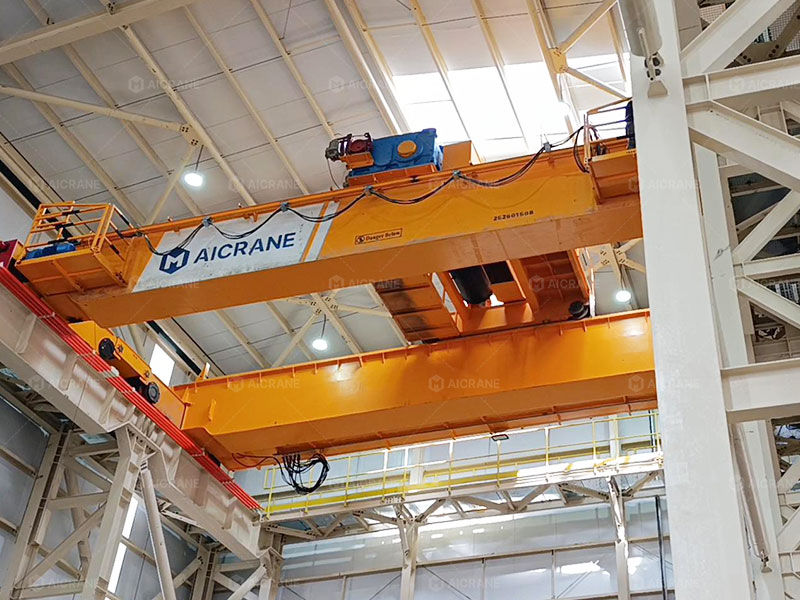
1. The Structural Foundation of a 100 Ton Overhead Crane
A typical 100 ton overhead crane is usually designed as a double girder overhead bridge crane, which provides the strength and stability required for heavy-duty lifting operations.
Its main structural components include:
Main girders (double box girder or reinforced box structure)
End carriages (end trucks with wheel assemblies)
Trolley system with hoisting mechanism
Cross beams and structural stiffeners
Runway beams and rail support system
Operator cabin (optional depending on application)
The entire structural system works as a load transfer chain:
Load → Hook → Trolley → Main Girder → End Carriage → Runway Beam → Building Structure
At a 100-ton capacity level, the crane structure must handle not only static loads but also dynamic factors such as acceleration, braking forces, load swing, and frequent duty cycles typically classified as A6–A8 working duty.
2. High-Strength Steel and Weight Optimization Design
One of the most important trends in modern overhead crane structural engineering is the use of high-strength low-alloy steel (HSLA steel) and advanced lightweight optimization.
Traditionally, cranes relied on heavier steel structures to ensure safety. However, modern design methods now prioritize strength-to-weight efficiency.
Key developments include:
Use of Q355 and higher-grade structural steel instead of conventional carbon steel
Reduced dead weight of the main girder without sacrificing strength
Optimized stress distribution through computational design
Improved fatigue resistance under repeated loading cycles
Finite Element Analysis (FEA) is widely used to simulate stress distribution across the crane structure. Engineers can identify high-stress zones and reinforce only necessary areas, reducing unnecessary material usage.
The benefits of this approach include:
Lower steel consumption and manufacturing cost
Reduced load on building support structures
Improved energy efficiency during crane movement
Easier transportation and on-site installation
3. Advanced Box Girder Structural Design
For 100 ton overhead cranes, the double box girder structure remains the most widely used configuration due to its excellent torsional rigidity and load-bearing capacity.
However, modern structural design has significantly improved traditional box girder construction.
Key improvements include:
Internal diaphragm reinforcement for better stress distribution
Optimized rib placement based on simulation data
Fully automated submerged arc welding (SAW)
High-precision robotic welding for uniform joint quality
Non-destructive testing (NDT) such as ultrasonic and radiographic inspection
These advancements ensure that the girder structure can withstand long-term cyclic loading without deformation or fatigue cracking.
In high-temperature or high-duty environments such as steel mills, the box girder structure is often designed with additional thermal stress allowances and reinforced end sections to improve durability.

4. Modular Structural Design for Faster Production and Installation
Modern industrial projects increasingly demand shorter delivery and installation timelines. To meet this requirement, crane manufacturers are adopting modular structural design principles.
Instead of fabricating the crane as a single large structure, components are divided into standardized modules:
Main girder sections
End carriage assemblies
Trolley units
Electrical and control systems
These modules are manufactured separately and assembled on-site.
Advantages of modular structural design include:
Faster manufacturing and quality control
Simplified transportation logistics
Reduced on-site installation time
Easier maintenance and replacement of components
Improved customization flexibility for different spans and capacities
This approach is especially beneficial for international projects where shipping and installation conditions vary significantly.
5. Improved Fatigue Resistance and Structural Lifespan Design
A 100 ton overhead crane is typically used in high-frequency industrial environments where fatigue failure becomes a critical design factor.
Modern structural design now focuses heavily on fatigue life prediction and stress cycle analysis.
Key engineering strategies include:
Fatigue-rated weld joint design
Smooth stress transition zones in girder connections
Reinforced wheel load contact areas
Reduced stress concentration at beam intersections
Advanced simulation tools allow engineers to estimate the crane’s lifespan based on real operational cycles rather than theoretical static loads.
In modern heavy industry, it is common for a 100 ton overhead crane to be designed for a 20–30 year service life, depending on duty class and maintenance conditions.
6. Structural Stability Under Dynamic and Extreme Conditions
Another major trend in 100t double girder overhead crane design is improved structural stability under dynamic loads and environmental stress.
Modern cranes must withstand:
Sudden load impact during lifting
Load swinging during trolley movement
Wind pressure in outdoor applications
Seismic forces in certain regions
To address these challenges, engineers now integrate:
Reinforced end carriage alignment systems
Anti-sway structural geometry
Improved wheel load distribution design
Flexible yet controlled structural deflection limits
These improvements ensure stable operation even under complex working conditions, especially in shipyards and steel fabrication plants.
7. Integration of Smart Monitoring into Structural Systems
Although structural design is primarily mechanical, modern cranes increasingly integrate structural health monitoring systems.
Sensors are embedded into key structural points to monitor:
Stress and strain levels
Vibration behavior
Load distribution across girders
Long-term fatigue accumulation
This allows operators to detect early signs of structural wear before failure occurs.
Benefits include:
Preventive maintenance planning
Reduced downtime
Extended crane lifespan
Improved operational safety
This shift from reactive to predictive maintenance is becoming a standard requirement in modern heavy industry projects.
8. Application-Driven Structural Customization
Different industries require different structural configurations for 100 ton overhead cranes:
Steel plants: heat-resistant reinforced girders
Shipyards: long-span structures with high lateral stability
Power stations: precision lifting with controlled deflection
Heavy fabrication workshops: compact high-strength designs
This has led to a trend of application-specific structural engineering, where cranes are no longer standardized products but customized engineering systems.
Manufacturers now design cranes based on:
Span length
Duty classification
Working environment
Load frequency
Installation conditions
Conclusion
The structural design of 100 ton overhead cranes has evolved significantly in modern industry. The focus has shifted from simple load-bearing capability to a more advanced engineering approach that combines material optimization, fatigue resistance, modular construction, structural simulation, and intelligent monitoring.
These trends reflect the growing demand for safer, more efficient, and longer-lasting lifting equipment in global industrial operations.
As industries continue to modernize, overhead crane structural design will become even more data-driven, precise, and application-specific, ensuring that heavy lifting operations remain reliable under increasingly complex working conditions.


Comments