


High Lifting Height Design Features of 50 Ton Gantry Cranes

Gantry cranes are among the most versatile lifting machines used across various industries such as manufacturing, construction, steel handling, shipping yards, and precast concrete production. When handling extremely heavy loads, a 50-ton gantry crane is often a preferred choice due to its balance between lifting capacity and operational flexibility. One of the most critical aspects of these cranes is their ability to achieve high lifting heights, which ensures they can lift and maneuver bulky or stacked loads safely and efficiently. In this article, we explore the design features that enable 50-ton gantry cranes to achieve high lifting heights and the engineering considerations involved in optimizing their performance.

Understanding Lifting Height
The lifting height of a gantry crane refers to the vertical distance from the crane hook’s lowest position (when the hook is fully lowered) to its highest position (when fully raised). For a 50 ton gantry crane for sale, the lifting height is often designed to accommodate operations involving stacked materials, high-precast components, or containers. The lifting height is crucial in ensuring operational efficiency, preventing collisions with the crane structure, and providing adequate clearance for the load during transport.
Key Design Features Supporting High Lifting Heights
1. Robust Girder and Boom Structures
The main girder and boom of a 50-ton gantry crane must be engineered to handle not only the vertical load but also the bending moments created when lifting loads to great heights. Typically, double-girder designs are preferred for high lifting cranes because they provide greater structural rigidity and distribute the load more evenly across the crane span. High-strength steel is often used for both the girder and supporting legs to prevent deflection and maintain stability under heavy loads.
2. Optimized Hoist Mechanism
The hoist is the core lifting component of any gantry crane. For high lifting heights, the hoist must be capable of extended vertical travel without compromising speed or safety. Modern 50-ton gantry cranes use either wire rope hoists or chain hoists designed for high lift operations. Wire rope hoists, in particular, are advantageous for high lifting applications due to their ability to spool large lengths of cable while maintaining smooth operation. The hoist drum is sized appropriately to accommodate the rope length required for the crane’s maximum lifting height.
3. Extended Leg Height and Adjustable Gantry Frame
The gantry frame’s height directly influences the crane’s maximum lifting height. For a 50-ton gantry crane, the vertical legs are designed to provide sufficient clearance for the load at the topmost position. Some cranes incorporate telescopic or adjustable leg designs that allow operators to modify the height based on operational needs, thereby enhancing flexibility without sacrificing stability.
4. Advanced Crane Rail and Travel Systems
To complement the lifting height, the crane’s horizontal travel system must be carefully engineered. Rails are laid with precise leveling to ensure smooth movement of the crane trolley and hook over long distances, which becomes more critical as the lifting height increases. The interaction between vertical lifting and horizontal travel must be seamless to prevent oscillation or sway that could compromise load safety.
5. Anti-Sway and Load Stabilization Features
As the lifting height increases, the risk of load swing becomes more pronounced. High lifting cranes are therefore equipped with anti-sway systems or load stabilization mechanisms. These can include mechanical dampers, electronic sway control, or active pendulum suppression systems. By minimizing lateral movement, these systems allow operators to lift and position heavy loads accurately, even at maximum heights.
6. High-Performance Motors and Braking Systems
The vertical travel of heavy loads to high positions requires motors capable of providing consistent torque and speed control. Electric hoists on 50-ton gantry cranes often utilize variable frequency drive (VFD) motors to ensure smooth acceleration and deceleration. Additionally, high-performance braking systems are critical for safety, preventing uncontrolled descent of the load and maintaining precise positioning at elevated heights.
7. Structural Reinforcements for Wind and Load Stability
High lifting gantry cranes are more susceptible to lateral forces caused by wind, particularly in outdoor environments such as ports or construction sites. Engineers often incorporate structural reinforcements such as cross bracing, stiffening plates, and heavier footings to resist tipping or sway. For cranes with high lifting heights, even small oscillations can have significant safety implications, making these reinforcements essential.
8. Optimized Hook and Trolley Design
The trolley system, which moves along the crane girder carrying the hoist and hook, must be designed to operate efficiently at extended heights. The trolley wheels are sized to distribute the weight evenly and reduce stress on the crane girder. In addition, the hook block is often designed with multi-layer sheaves to accommodate the longer hoist rope required for high lifting, while maintaining compact dimensions to avoid excessive hook swing.
9. Operator Visibility and Control Systems
Lifting heavy loads to high positions requires precise operator control. Modern 50-ton gantry cranes include features such as cabin-mounted cameras, remote control systems, and load indicators to enhance operator visibility and safety. These systems allow operators to monitor load positioning and prevent collisions with the crane structure or surrounding obstacles.
10. Compliance with Safety Standards
High lifting operations must adhere to rigorous safety standards, including ISO, FEM, or local industrial regulations. These standards dictate maximum permissible loads, structural design safety factors, and operational guidelines. A 50-ton double beam gantry crane designed for high lifts incorporates these safety measures from the initial design phase, ensuring that both personnel and equipment are protected during operation.
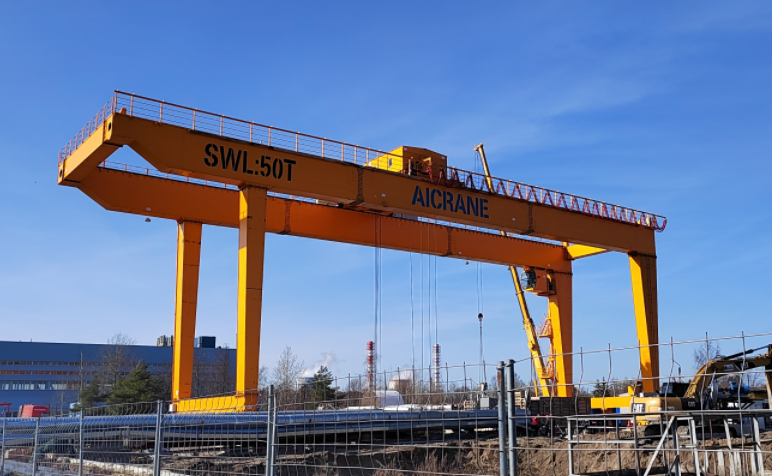
Applications of High Lifting Height 50 Ton Gantry Cranes
High lifting 50-ton gantry cranes are widely used across industries where vertical space is limited or loads need to be positioned at elevated levels. Common applications include:
Precast Concrete Production: Lifting and stacking large precast beams or slabs in storage yards.
Steel Handling: Moving heavy steel coils or structural steel components in warehouses and factories.
Container Handling: Loading and unloading shipping containers in port terminals.
Machinery Installation: Assisting in the vertical positioning of heavy machinery or equipment in manufacturing plants or power stations.
Conclusion
The design of a 50-ton gantry crane with a high lifting height is a complex engineering task that requires careful consideration of structural strength, hoist capabilities, stability, and safety systems. Features such as robust girders, extended leg height, advanced hoists, anti-sway mechanisms, and high-performance motors all work in unison to enable safe and efficient lifting to elevated positions. By understanding these design elements, industries can select the right gantry crane for their specific needs, ensuring high productivity, operational safety, and long-term reliability.
For businesses seeking reliable lifting solutions, high lifting height 50-ton gantry cranes offer a perfect balance of capacity, flexibility, and safety, making them indispensable in modern heavy lifting operations.


Comments