


Impact of Duty Class on 30 Ton Overhead Crane Design

Overhead cranes are critical components in industrial and manufacturing facilities, enabling the lifting, moving, and precise positioning of heavy loads. Among these, a 30-ton overhead crane is considered a heavy-duty lifting solution, commonly used in steel mills, manufacturing plants, shipyards, and warehouses. While selecting or designing such a crane, one of the most crucial factors to consider is the duty class, which directly influences its structural design, components, operational safety, and service life. Understanding how duty class affects crane design is essential for engineers, facility managers, and crane manufacturers to ensure reliability, efficiency, and compliance with safety standards.

Understanding Duty Class
Duty class, sometimes referred to as service class or crane classification, defines the expected operating conditions and frequency of use for an overhead crane. It is a standard outlined in various international guidelines, including ISO 4301-1 and European FEM standards. Duty class considers factors such as:
Load spectrum: How often the crane will lift its rated capacity.
Operating frequency: Number of lifting cycles per hour.
Operational environment: Temperature, dust, humidity, or corrosive conditions.
Impact and shock loads: Whether loads are lifted smoothly or with jerks and sudden starts/stops.
Duty class is commonly denoted as M, H, or A5, A6, etc., depending on regional standards. For example, in the FEM system, duty classes range from M1 (light usage) to M8 (very heavy usage), with the corresponding ISO designations like A3, A4, A5, A6, and so on.
For a 30 ton overhead crane, understanding the duty class is vital because it directly affects the crane’s structural components, hoist design, mechanical systems, and safety measures.
Influence of Duty Class on Structural Design
The main girder, end beams, and runway system of an overhead crane are designed based on the load conditions anticipated by the duty class. Higher duty classes require cranes to withstand greater dynamic loads, repeated stress cycles, and possible impact from load swinging. This has several implications:
Main Girder Design:The main girder must support the weight of the trolley, hoist, and load while minimizing deflection and vibration. For light duty overhead cranes (e.g., M3/A3), a simpler I-beam or box-section girder may suffice. However, for heavy-duty operation (e.g., M6/A5), the girder must be thicker, reinforced, or constructed as a box-section with higher moment of inertia to resist bending and fatigue.
End Beam and Runway Considerations:Higher duty classes generate higher forces at the crane runway and end trucks. As duty class increases, end beams require reinforced connections to the main girder, and the runway must be capable of absorbing increased wheel loads without permanent deformation. For a 30-ton crane operating in a continuous heavy-duty environment, the runway rails often require wider flanges, higher-grade steel, and stronger anchoring systems.
Fatigue Analysis:Overhead cranes experience cyclic loading. Higher duty classes mean more frequent lifting cycles, which can cause metal fatigue over time. Structural members must be designed using fatigue-resistant materials and optimized welds to prevent premature failure. This is especially critical for cranes lifting 30 tons, where stress concentrations can quickly escalate under repetitive heavy lifting.
Impact on Hoist and Trolley Design
The hoist and trolley system must be tailored to match the crane’s duty class. Key considerations include:
Motor Rating and Duty Cycle:Higher duty class cranes require hoist motors capable of sustaining frequent starts and stops without overheating. For example, a 30-ton crane operating under duty class A5 might require hoist motors rated for 60–80% duty cycle, whereas a lower duty class crane could use smaller motors with shorter operating limits.
Wire Rope and Drum Design:Wire ropes and drums must accommodate repeated stress and bending. Duty class influences rope diameter, drum grooves, and lubrication systems to ensure longevity under high cycles.
Gearbox and Brake Selection:For heavy-duty cranes, the hoist gearbox must be robust enough to handle shock loads and prevent premature wear. Similarly, braking systems must be redundant and capable of holding full loads safely during frequent operations.

Electrical System Considerations
Duty class affects the electrical and control system design of a 30-ton overhead crane. High duty classes often necessitate:
Heavier-duty contactors and switches to handle frequent starts and stops.
Advanced variable frequency drives (VFDs) for smooth acceleration and deceleration, minimizing mechanical stress and swaying.
Enhanced safety interlocks and sensors to prevent overloading or collisions during continuous operation.
Electrical components must be rated to operate reliably in harsh industrial environments where dust, moisture, or temperature extremes are present.
Safety and Compliance Requirements
Duty class directly correlates with safety standards for crane operation. A higher duty class increases the likelihood of fatigue, mechanical failure, or operational errors. To mitigate risks:
Regular inspection intervals are shortened for cranes with high duty classes.
Load monitoring systems may be integrated to detect overloads in real-time.
Anti-sway and anti-collision devices become more critical in continuous or heavy-duty operations.
Additionally, compliance with ISO, FEM, and national standards requires that duty class be clearly defined in design specifications, documentation, and operator manuals.
Cost Implications
Higher duty classes generally result in higher capital and operational costs due to:
Heavier and more robust structural components.
Higher-rated hoist motors, gearboxes, and brakes.
More advanced control systems and safety devices.
Increased maintenance frequency and potential spare parts inventory.
For a 30-ton overhead crane, a duty class A5 crane can cost significantly more than an A3 crane, but the investment is justified for long-term reliability and minimized downtime in heavy-duty operations.
Case Study Example
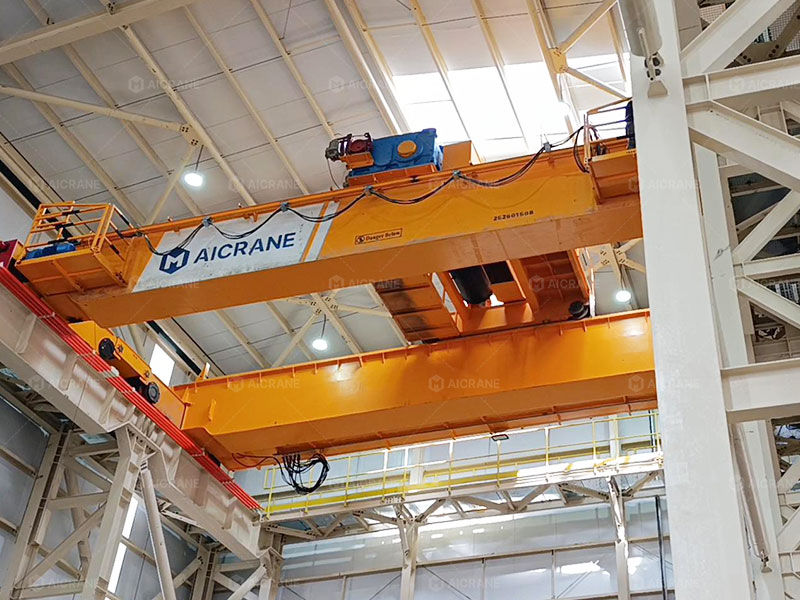
Consider a 30-ton double girder overhead crane designed for a steel mill:
Duty Class: A5 (heavy usage, 40 cycles per hour)
Span: 20 meters
Lifting Height: 12 meters
Design adjustments due to duty class included:
Main girder reinforced with box-section steel, increasing the moment of inertia to handle dynamic loads.
Hoist motors upgraded to 110 kW, rated for high-frequency operation.
Wire rope diameter increased, with improved lubrication system to reduce wear.
Advanced VFD-controlled trolley system for smooth start-stop motion, reducing shock load on crane and load.
Brake system upgraded to dual-disc hydraulic brakes, ensuring safety even under continuous operation.
Without considering duty class, this crane could experience accelerated wear, unexpected downtime, and higher maintenance costs.
Conclusion
Duty class is a critical parameter in the design of a 30-ton overhead crane, affecting nearly every aspect of the crane’s structure, mechanics, and operation. It determines the strength of structural components, hoist and trolley specifications, electrical system requirements, safety features, and maintenance protocols. Underestimating duty class can lead to premature failure, operational inefficiencies, and safety hazards, while overestimating it may result in unnecessary capital expenditure.
For engineers and facility managers, it is essential to accurately assess the operational demands of the crane, including load frequency, operational environment, and expected life cycle, before finalizing design specifications. By doing so, a 30-ton overhead crane can deliver reliable, safe, and efficient performance tailored to its intended industrial application.
Ultimately, duty class is not just a technical specification—it is a guiding principle that ensures the crane can handle the real-world demands of heavy lifting while maintaining longevity, safety, and operational efficiency.


Comments