


How to Prevent Deformation in 100 Ton Gantry Crane Main Structure

Preventing deformation in a 100 ton gantry crane main structure is one of the most critical aspects of ensuring long-term safety, operational stability, and cost efficiency. Because cranes of this capacity are used in heavy industries such as shipbuilding, steel production, precast concrete handling, and large-scale logistics, even minor structural deformation can lead to misalignment, reduced lifting precision, accelerated fatigue, and in severe cases, structural failure.
Unlike smaller lifting equipment, a 100 ton gantry crane operates under extreme and repeated load cycles. The main girder, supporting legs, end carriages, and connections are continuously subjected to a combination of static load, dynamic impact, wind load, rail irregularities, and thermal stress. Preventing deformation is therefore not a single action, but a combination of proper design, fabrication quality, installation accuracy, operational control, and long-term maintenance strategy.
Below is a detailed breakdown of the key methods and engineering practices used to prevent deformation in the main structure of a 100 ton gantry crane.

1. Proper Structural Design and Load Analysis
The foundation of deformation prevention starts at the design stage. A 100 ton gantry crane must be designed using precise load calculations that consider both vertical and horizontal forces.
Engineers must account for:
Rated lifting load (100 tons)
Dynamic impact factor (typically 1.1–1.3 depending on duty class)
Self-weight of the crane structure
Wind load (especially for outdoor gantry cranes)
Seismic conditions (if applicable)
Trolley acceleration and deceleration forces
Advanced finite element analysis (FEA) is widely used to simulate stress distribution across the main girder and supporting legs. This helps identify potential weak points where deformation may occur under repeated loading.
A key design principle is controlling deflection. For example, the allowable deflection of the main girder is typically limited to L/800 to L/1000 depending on crane classification. Keeping deflection within limits ensures that long-term plastic deformation does not occur.
2. Selection of High-Strength Structural Steel
Material selection plays a major role in preventing permanent deformation. High-quality low-alloy structural steel such as Q355B or equivalent is commonly used in heavy duty gantry cranes.
Key material requirements include:
High yield strength to resist plastic deformation
Good toughness to withstand impact loads
Stable performance under temperature variations
Excellent weldability for large structural assemblies
Using substandard steel or inconsistent material grades is one of the most common causes of early structural deformation. Even small variations in material thickness or strength can lead to uneven stress distribution in a 100 ton structure.
3. Precision Fabrication and Welding Control
Even with perfect design and material selection, poor fabrication can introduce residual stresses that lead to deformation over time.
During manufacturing, strict control must be applied to:
Welding Sequence
Incorrect welding order can cause uneven thermal shrinkage, leading to permanent bending or twisting of the main girder. A balanced welding sequence is used to distribute heat evenly.
Welding Quality
All welds must meet non-destructive testing (NDT) standards such as ultrasonic testing (UT), radiographic testing (RT), or magnetic particle inspection (MT). Defective welds can create weak points that deform under cyclic loading.
Machining Accuracy
Critical interfaces such as rail mounting surfaces and flange connections must be machined to tight tolerances. Even minor inaccuracies can cause uneven load distribution across the structure.
Stress Relief Treatment
For large 100 ton gantry cranes, post-weld heat treatment (PWHT) or vibration stress relief is often used to reduce internal residual stresses that could lead to long-term deformation.
4. Structural Reinforcement Design
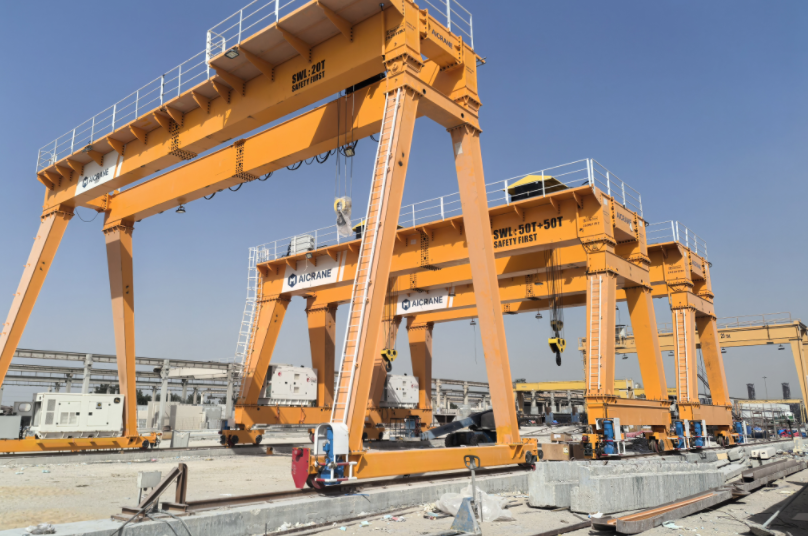
To prevent deformation, engineers often reinforce key stress zones in the crane structure.
Common reinforcement strategies include:
Adding internal diaphragms inside box girders
Increasing flange thickness at high-stress zones
Using double-web or box-type girder designs instead of single beam structures
Reinforcing leg-to-girder joints with gusset plates
These reinforcements help distribute stress more evenly, reducing localized deformation over time.
In 100 ton gantry cranes, box girders are preferred because they provide high torsional rigidity and better resistance against bending compared to I-beam structures.
5. Precision Installation and Rail Alignment
Even a perfectly manufactured crane can deform if installation is not properly executed.
Installation factors that directly affect deformation include:
Rail Leveling
If crane rails are not level or have uneven settlement, the crane legs will experience uneven loading, causing torsional stress in the main girder.
Span Accuracy
Incorrect rail spacing can introduce pre-stress into the crane structure. Over time, this leads to gradual deformation.
Foundation Stability
Concrete foundations must be designed to handle both vertical and lateral loads. Weak foundations may settle unevenly, causing structural misalignment.
Wheel Alignment
Misaligned wheels cause skewing during travel, which generates lateral forces that twist the gantry structure.
Proper installation ensures that the crane operates under uniform load conditions, significantly reducing deformation risk.
6. Load Management and Operational Control
Operational behavior has a direct impact on structural deformation. Even a well-designed 100 ton gantry crane can deform if it is misused.
Key operational guidelines include:
Avoid Overloading
Repeated operation near or above rated capacity accelerates fatigue deformation in the main girder.
Controlled Acceleration and Braking
Sudden starts and stops generate dynamic shock loads. Modern cranes use variable frequency drives (VFDs) to smooth motion and reduce impact stress.
Balanced Lifting
Uneven load distribution during lifting can twist the structure. Operators must ensure proper center-of-gravity alignment before lifting.
Limit Side Pulling
Side loading introduces lateral stress that gantry cranes are not designed to handle, leading to long-term structural distortion.
7. Wind Load Protection for Outdoor Gantry Cranes
For outdoor 100 ton gantry cranes, wind load is a significant factor in deformation risk.
Preventive measures include:
Rail clamps to secure crane during idle conditions
Wind speed monitoring systems with automatic shutdown
Structural design optimized for regional wind loads
Anchor points or storm locks
Strong wind can cause lateral movement or racking deformation if the crane is not properly secured.
8. Regular Inspection and Structural Health Monitoring
Preventing deformation is not only about design and installation—it also requires continuous monitoring.
Inspection programs should include:
Visual inspection of weld joints and structural joints
Measurement of main girder deflection
Rail alignment checks
Crack detection using ultrasonic or magnetic testing
Monitoring of bolt tension in key connections
Advanced systems may include structural health monitoring sensors that track strain, stress, and vibration in real time. This allows early detection of abnormal deformation trends before they become critical.
9. Fatigue Management and Lifecycle Planning
A 100 ton gantry crane operates under repeated load cycles, making fatigue one of the main causes of long-term deformation.
To manage fatigue:
Define duty classification properly (A5–A7 for heavy-duty cranes)
Avoid continuous operation beyond designed working cycles
Implement planned maintenance shutdowns
Replace high-stress components before fatigue limits are reached
Fatigue cracks often begin at weld joints or stress concentration areas, gradually leading to structural deformation if not addressed early.
10. Operator Training and Safety Awareness
Human factors are often underestimated in structural deformation prevention. Proper training ensures that operators understand:
Correct lifting procedures
Load distribution principles
Effects of side pulling and shock loading
Importance of smooth crane operation
Well-trained operators significantly reduce the risk of accidental overload and misuse, both of which are major contributors to deformation in heavy gantry cranes.
Conclusion
Preventing deformation in a 100 ton gantry crane main structure requires a holistic engineering approach that integrates design accuracy, material quality, fabrication control, precise installation, disciplined operation, and continuous inspection.
Deformation is rarely caused by a single factor. Instead, it is the result of accumulated stresses over time—whether from poor alignment, repeated overload, welding imperfections, or harsh environmental conditions.
By applying strict engineering standards and proactive maintenance strategies, operators can significantly extend the service life of a 100 ton gantry crane, maintain structural integrity, and ensure safe and efficient lifting operations in demanding industrial environments.


Comments